
Subprocess Isolation
Each workflow step executes in a dedicated subprocess boundary, preventing shared state contamination and enabling clean recovery.
An enterprise control plane for deterministic automation and governed agentic execution.
Modern AI systems combine language models, tools, workflows, and distributed compute. Without centralized governance, these systems accumulate operational risk: silent failures, uncontrolled retries, policy drift, and unbounded cost.
Bot Velocity provides the architectural foundation to operate intelligent workflows with infrastructure-grade discipline — explicit state transitions, authoritative execution ownership, structured observability, and evaluation as part of the lifecycle.
Every workflow run is governed by a strict lifecycle model. State transitions are explicit, retries are centrally authorized, and execution ownership is never ambiguous.
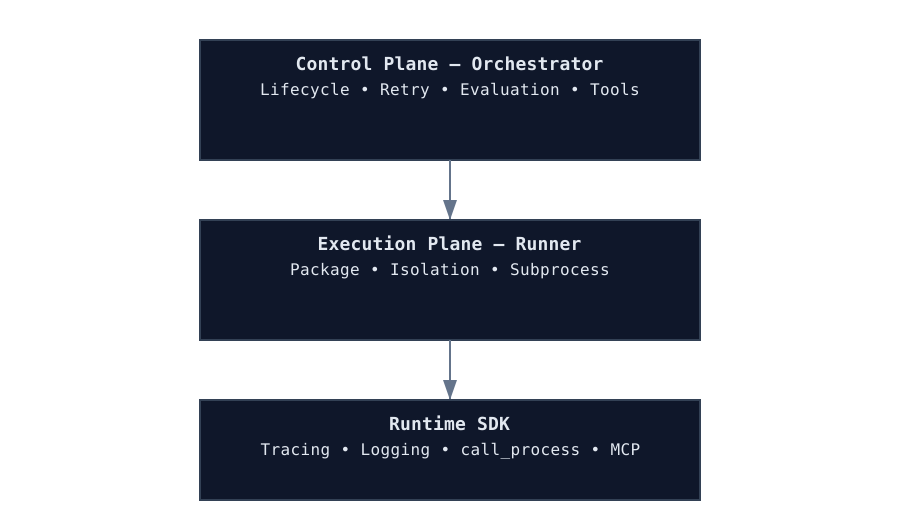
Intelligent steps execute inside isolated runner subprocesses. The execution plane enforces containment boundaries while the control plane maintains authoritative lifecycle management.
Agent behavior remains observable, recoverable, and policy-aware — without sacrificing adaptability.
Each workflow step executes in a dedicated subprocess boundary, preventing shared state contamination and enabling clean recovery.
Runners acquire time-bounded leases. Active heartbeats extend ownership; missed heartbeats trigger automatic reclaim to prevent stalled executions.
Configurable execution timeouts prevent runaway resource consumption and ensure bounded operational risk.
Tool execution, evaluation, and policy enforcement operate under the same governance model. Agents do not bypass orchestration — they operate within it.
External and internal tools are exposed through a controlled protocol layer with scoped access and auditable invocation paths.
Baseline comparison, regression detection, flaky analysis, and policy checks operate on real execution artifacts.
Evaluation thresholds integrate directly into release workflows, blocking unsafe changes before they reach production.
A purpose-built CLI and runtime SDK support packaging, publishing, nested process invocation, and structured instrumentation.
Hierarchical span tracing captures execution flow across steps, model calls, and tool invocations. Token usage and cost are aggregated per run for operational transparency.